Control & Guidance LabsInteractive course materialsRuns in your browser

English review collection. Expanded course notes and simulations are drafts for technical review. Activities are ungraded practice; model assumptions are stated in each guide.

Graduate robotics · nonlinear control · marine systems

Learn the theory.
See the dynamics.

A small collection of interactive control-engineering laboratories. Explore why equilibria are stable, then discover how multiple autonomous vehicles can follow different paths while coordinating their motion.

03 learning modules05 stability examples2–5 coordinated USVs0 software installs
FROM SINGLE-SYSTEM STABILITY TO TEAM CONTROL● LIVE IDEAS
Stability analysisCooperative guidance
V̇(x) ≤ 0 · Stabilitysᵢ + dᵢ · Progress coordination
01 / Interactive tools

Choose a simulator

Each experiment runs independently in your browser. Change gains, initial conditions, vehicle settings and disturbances, then export data for further analysis.

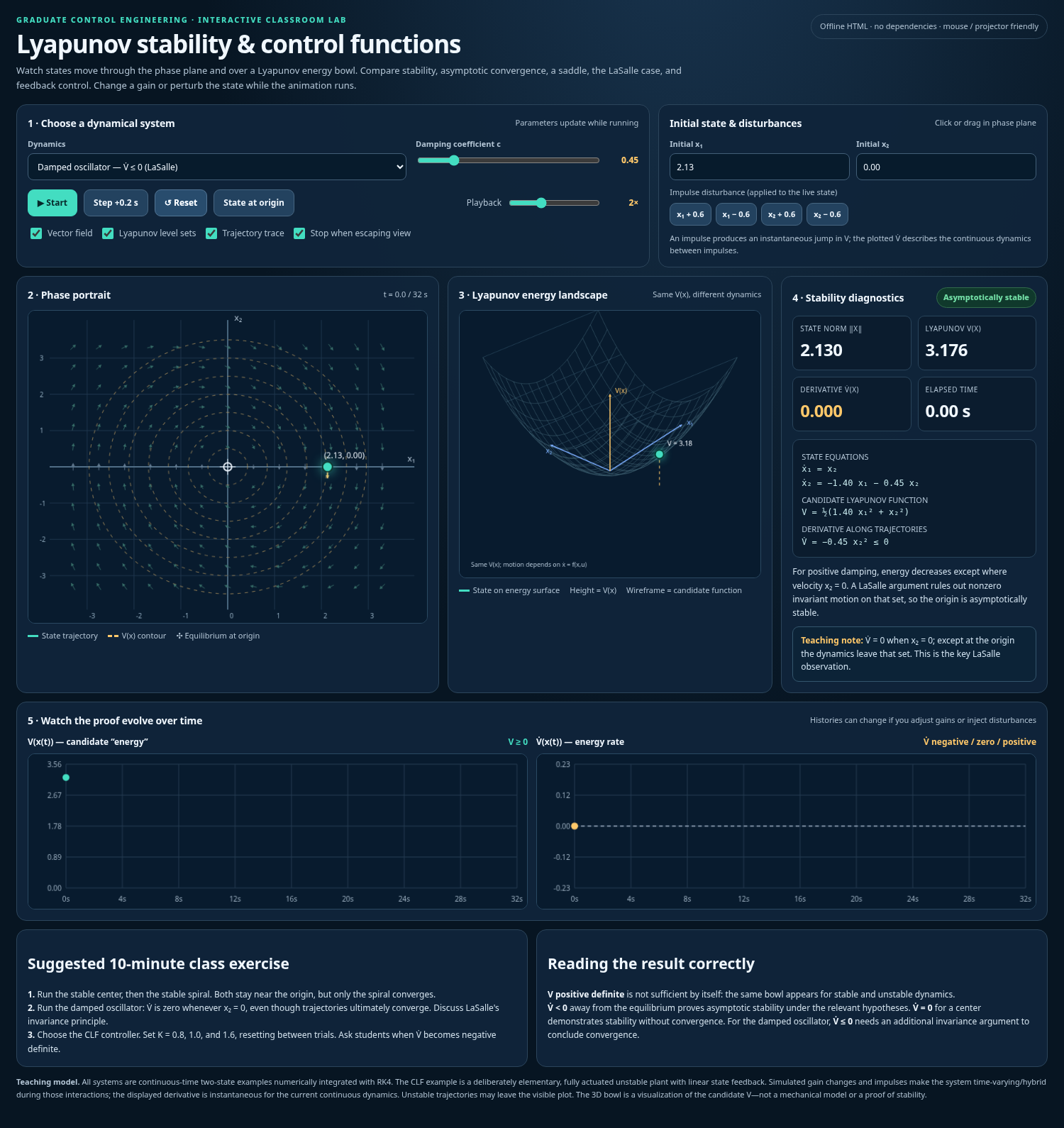
Screenshot of the Lyapunov simulator showing a phase portrait, energy landscape and stability diagnosticsModule 01 · nonlinear control
FOUNDATIONS

Lyapunov stability
& control functions

Watch state trajectories move through a phase plane and across Lyapunov contours. Compare stability, convergence, LaSalle’s principle and a feedback law built from a control Lyapunov function.

Phase portraitsV and V̇ historiesCLF gain designCSV export
  • Stable center, asymptotic spiral, damped oscillator, unstable saddle
  • Adjust feedback gain and observe the CLF stability threshold
  • Modify initial state and introduce disturbances
USVeᵧΔLOS pointModule 02 · single vehicle
MARINE PATH-FOLLOWING GUIDANCE

Line-of-sight
(LOS) guidance

Explore how a marine robot converges to a reference path using a geometric lookahead point. Watch steering, signed cross-track error and the Lyapunov candidate evolve in real time.

Lookahead ΔCross-track errorYaw responseOcean current
  • Visualize path tangent, LOS point, desired course and actual heading
  • Compare short versus long lookahead and tangent-only guidance
  • Observe uncompensated current drift and current compensation
target 1target 2target 3Module 03 · cooperative robotics
MULTI-ROBOT GUIDANCE

LOS & coordinated
virtual targets

Control a fleet of two to five USVs following straight, curved or sinusoidal routes. Compare independent guidance against coordinated virtual-target progression, path-station slots and leader–wingman behavior.

2–5 USVsWingman formationsVT speed & x-shiftsCommunication faults
  • Independent LOS and virtual-target modes, with or without coordination
  • Set path shapes, individual sine phase shifts and target speed
  • Evaluate synchronization versus actual vehicle separation
02 / Suggested sequence

From theory to coordinated motion

A recommended progression for students who already know basic feedback control and linear systems.

STEP 01 · 15–20 MIN

Understand stability

Predict whether V decreases, stays constant or can grow. Compare phase portraits with the formal conditions for stability.

Read the concepts ↗
STEP 02 · 15–20 MIN

Design feedback

Choose a control gain for an unstable plant. Verify the sign of V̇ and find the threshold for convergence.

Open CLF experiment ↗
STEP 03 · 20–30 MIN

Follow a path, then coordinate a fleet

Use the dedicated LOS simulator to establish local path convergence. Then introduce a speed-limit fault. Compare following the path, following the virtual target and keeping the formation together.

Read the guidance notes ↗
Expanded English notes

Study the derivations

Student notes with assumptions, worked examples and limitations. English drafts for instructor review.

Single-vehicle teaching supplement

Virtual target & moving Frenet frame

Isolate target-rate and yaw-control terms, then resolve the displacement derivative into vehicle translation, target translation and frame rotation.

Open single-vehicle animation →
03 / Lecture material

Study resources

Original student handouts are available directly on this site; external slides and readings link to their authors’ original pages.

04 / Practical activities

Try it, record it, explain it

Short activities for class or homework, with a prediction before each run and a quantitative result afterward.

20 MIN · STABILITY

Can a positive V guarantee convergence?

  1. Compare an undamped center and a stable spiral from the same initial state.
  2. Record the trajectories of V(t) and V̇(t).
  3. Find the range of feedback gains K for which the CLF example is asymptotically stable.
  4. Explain what changes at K = 1 and why a damped oscillator requires an invariance argument.
Deliverable: one plot and a short written justification.
25 MIN · MARINE ROBOTICS

Why doesn't path following imply coordination?

  1. Run three USVs with independent virtual targets and introduce a speed-limit fault.
  2. Repeat with coordinated virtual-target progression.
  3. Change VT speed and each sine path’s x-shift.
  4. Compare cross-track error, vehicle-to-target error and fleet progress error.
Deliverable: a comparison table and one key takeaway.
About the models and materials

The Lyapunov examples are idealized two-state dynamical systems. The marine simulator uses simplified kinematics and path-progress coordination; synchronization is not collision avoidance or a guarantee of a rigid Euclidean formation. The site itself uses static HTML/CSS and needs no runtime backend. External slides remain hosted by their original authors and require an internet connection.